GPS Fun with Geotagging Photos

•June 27, 2012 • Comments Off on GPS Fun with Geotagging Photos

One of the things I’ve wanted to do was photograph the features on the C&O Canal and be able to include the GPS coordinates of each feature and mile marker. Since I’ve been riding the canal on the bike, I have been using an “app” on my iPhone that records a track with GPS points along the way and the track can be saved and emailed to myself.

Fort Frederick, Maryland

On the computer, the new version of Adobe Lightroom can import the track into a new “Map” module. Using the date/time stamps I can insert the GPS coordinates into the images and view them on the map in Lightroom.

With the images geotagged, I was looking for a way to share the trip on the Web and discovered that my SmugMug account has a “Map This” feature.

So I have set up a selection of images from my Fort Frederick to Hancock bike trip for you to see the location of each shot. Check it out here.

Long Ride to Hancock

•June 27, 2012 • Comments Off on Long Ride to Hancock

Next trip on the canal I pushed the envelope with the bike and rode the towpath upstream from Frederick State Park all the way to Hancock, just over 12 miles. For the return trip I took the Western Maryland Rail Trail, for a total round trip of just over 24 miles – my record for riding on the canal. I’ll have to admit I was really glad to get back to the car at that point. (I’m sure for those who are real bicycle enthusiasts, this was a piece of cake, but for my old legs it was a challenge.)

Starting at about the mile 12.5 point on the canal, I turned back just past the 24 mile marker. (I’ve been photographing all of the mile markers along the way, just to prove that I was there!) 😉


One of the more photogenic spots was Little Pool, between mile 12 and 121.

At lock 51, there are the ruins of the stone lockhouse, still impressive in their own way.

The window opening in the lockhouse gave me a place to set up the camera for a rare self-portrait.

Sidling Hill Creek and Fifteen Mile Creek Aqueducts

•June 22, 2012 • 2 Comments

I’ve been looking for opportunities to photograph the aqueducts on the C&O Canal for a couple of years. As a project, I felt that it was limited enough that I might actually be able to finish it. Some of the aqueducts were farther from the nearest parking to be able to walk comfortably but I expect the the bicycle will now get me to all of them eventually.

So I drove to the parking area at the upstream end of the Western Maryland Rail Trail and then rode upstream. My goal was to cross two aqueducts and photograph whatever else I could find along the way.

Right at the entrance to the towpath at Pearre is lock 56 and the lock house.

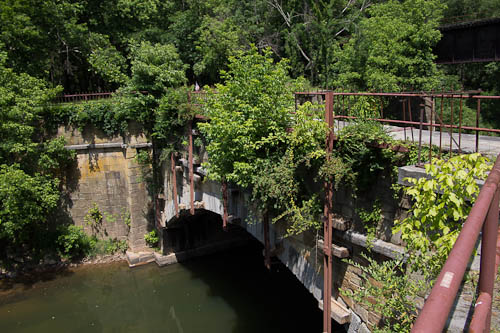
The Sidling Hill Creek Aqueduct is a little ways upstream. It is in generally poor condition, having been shored up with steel and wood beams. Also, the foliage has been working to take the whole thing over.  I will plan to return in the fall or early spring to get a better shot when the leaves are gone.

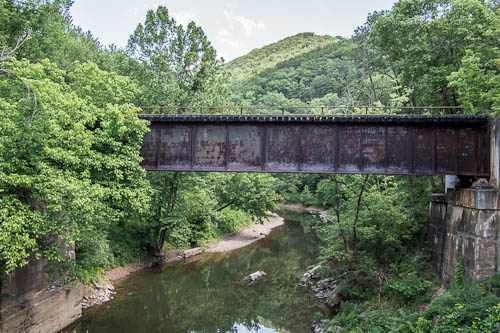
Just up the creek is one of the many structures that carried the Western Maryland Railroad. Now abandoned, the roadbed is ripe for development as and extension of the Western Maryland Rail Trail for bicyclers and hikers.

The Fifteen Mile Creek aqueduct is in much better shape and is one of the few aqueducts where the upstream wall is still intact.

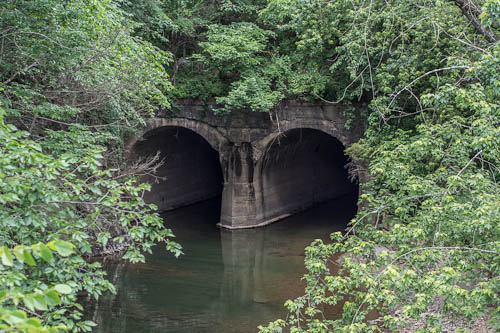
Almost completely hidden in the overgrown foliage is this interesting two arch viaduct for the railroad.

Jefferson County Farm Day

•June 19, 2012 • Comments Off on Jefferson County Farm Day

Last Saturday was Farm Day in Jefferson County. Several local farms are open for the public to learn about what they do. Malinda and I visited three of the locations to see what was going on and to take some photographs.

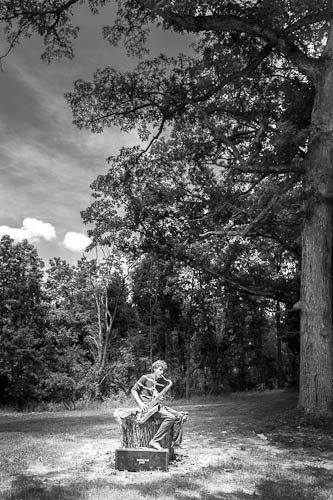
We had a nice chat with the young men who worked at the Bloomington Plantation Distillery  down on Route 9 south of Charles town. I noticed that there was a saxiphone on a nearby tree stump and was told that Adam liked to play when there was a lull in the activities. We asked him to play a bit and it certainly added a nice touch to the beautiful day in the country. I grabbed a couple of snapshots of Adam as he played.

As we were leaving, I looked back from the car and saw this:

Brunswick to Harpers Ferry

•June 18, 2012 • Comments Off on Brunswick to Harpers Ferry

For my next bicycle outing I decided to ride from Brunswick, Maryland up to Harpers Ferry, a distance of just under six miles. I went on an absolutely beautiful day – clear and warm without being too hot and a nice light breeze. The downside was that it was Sunday and there was a great deal of traffic on the towpath in this popular area. Nevertheless, it was an excellent ride of just over 13 miles round trip and I snapped away at the various things I saw along the way.

The first major feature I found was lift lock 31. The lockhouse is well preserved and the lock is in fair shape but has been allowed to fill up with foliage.

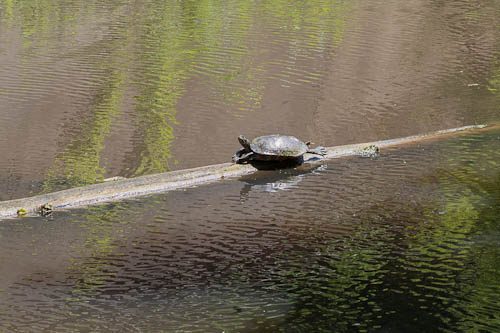
A little farther up I saw this turtle sunning himself (herself?) on a floating tree branch. These turtles populate the canal just about anywhere there is significant water in the canal.

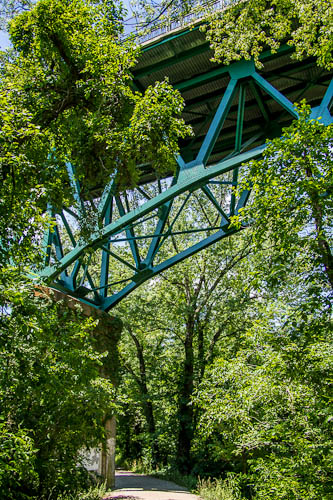
You can hear the traffic on Route 340 and the bridge over the Potomac is an imposing structure.

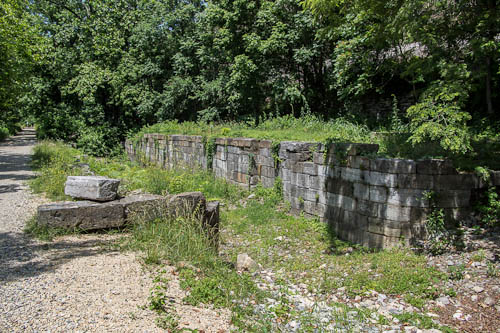
Lock 32 was in pretty bad shape.

Finally, at lock 33 at the railroad and footbridge that crosses the Potomac into Harpers Ferry, the lockhouse sits a the base of the impressive stone cliffs of Maryland Heights.

Round Top Cement Mill

•June 12, 2012 • Comments Off on Round Top Cement Mill

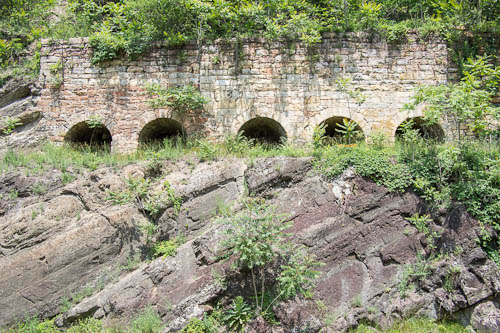
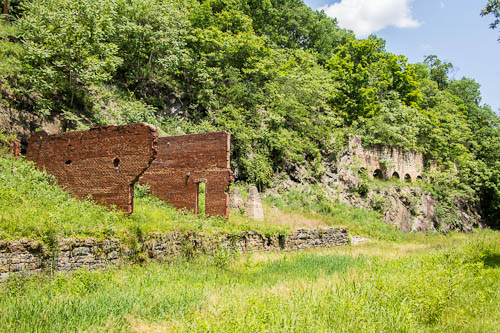
About three and a half miles upstream on the C&O Canal towpath from Hancock, Maryland are the ruins of the Round Top Cement Mill, one of the more interesting features on the canal. I parked in the lot by the boat ramp, just east of the Route 522 bridge and rode my bicycle up to the ruins. I had been interested in finding the ruins but it was too far for me to walk at this point. The bike has given me access to this and a lot of other things on the canal.

Bicycling & Photographing the C&O Canal

•June 9, 2012 • Comments Off on Bicycling & Photographing the C&O Canal

A couple of weeks ago I acquired a bicycle. I have been thinking about getting one for a while because I thought it would greatly increase my range of exploration of the C&O Canal, a subject of my fascination for several decades. I mentioned this to a friend who said that he had a bike he was not using and would I like to have it. Thanks to this generous offer, I could no longer drag my feet about whether or not to get a bike and accepted it as a long-term “loan”.

I have been out several times now and I am loving it. After my first tentative outing and a change to a more rear-end friendly seat, I am averaging something over 10 miles per trip and I have covered sections of the Canal that I have never been able to reach on foot.

One section was from Williamsport to Dam 5, a run of a little over seven miles. I was very glad not to have to try to walk it because it is a long stretch of very little by way of interesting features. Basically it’s a path through the tunnel of trees for most of the seven miles.

Nearly four miles into the trip I spotted an old house off in the trees on the berm side of the canal.

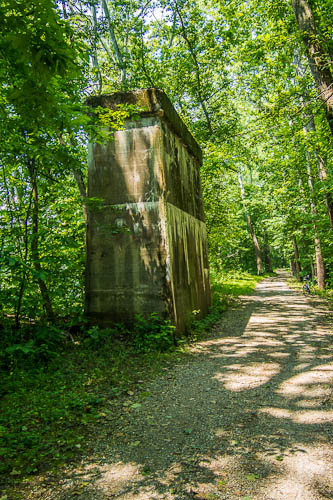
Then about a mile further down, the one surprise of the trip. In the middle of nowhere, a large bridge pier was sitting by the side of the towpath.

Looking through the trees I could make out additional piers in the river going across to the West Virginia side. Looking around on the web I discovered that this was from a railroad bridge (the Nessle Bridge) that was washed out in the flood of 1936.

Finally, my goal: Dam #5.

The dam was originally built to feed water to the canal. It is still used by Potomac Edison to generate power, the generation plant being on the West Virginia side of the river.

By the time I got back to Williamsport I had done almost 15 miles on the bike. A pretty good trek for only my second time out, especially since it had been nearly 20 years since I had ridden a bicycle any amount. This trip proves that I can still do it and I’m excited about the possibilities.

New Images at Ice House

•May 30, 2012 • Comments Off on New Images at Ice House

I’ve redone much of my print offerings out at the Ice House Artists’ Co-op in Berkeley Springs, WV. Among other things, I added two recent images to the framed work on the wall:

“The Table is Set” © Sterling Smith

This image was captured at the Adam Stephen House in Martinsburg, where the kitchen is set up with vintage artifacts to provide the environment of an 18th Century home.

“Givenchy” © Sterling Smith

The second image is of a great old building I found in Gormania, West Virginia. Yes, the building is leaning the way it looks in to photo.

So if you visit or live in Berkeley Springs, drop in and check out my new work and let me know what you think.

Capturing Digital Infrared

•May 16, 2012 • 2 Comments

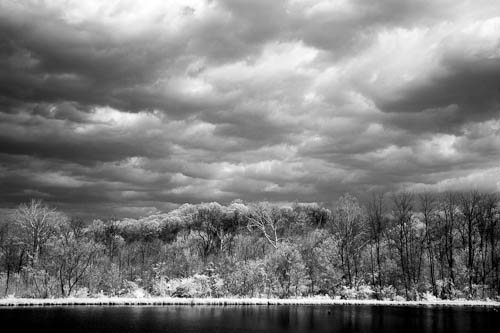
Infrared photography reveals a whole new range of color and tonal relationships that are unseen by the eye in visible light. Up until recently special film sensitive to infrared (IR) wavelengths was used and a dark infrared filter was needed over the lens to filter out visible light. Early digital cameras were sensitive to IR in varying degrees but the filter was still needed. This normally resulted in a lack of overall sensitivity that required slow shutter speeds, requiring a tripod, to capture enough light to make the exposure. Viewing through the lens was difficult because the dark filter made it very hard to see to focus and compose the shot.

My first attempts at IR photography were with my first digital camera, a 5 megapixel Minolta. I was able to test the IR sensitivity of the camera by aiming the TV remote into the lens and observing in the electronic viewfinder that I could see the remote’s infrared transmitter light up. I bought an IR filter on eBay and went out to try my luck with the hayfield just a few miles from my house on an absolutely fabulous day.

“Hayfield, Berkeley County WV” Minolta Dimage 5 Digital Camera with IR Filter

Infrared photography has become much easier with the ability to use modified digital cameras specifically for infrared capture. Most digital sensors are sensitive to IR but allowing the IR to reach the sensor in normal photography tends to degrade the sharpness of the image. This is because IR wavelengths focus at a different point on the focal point of the sensor. Some older lenses that were used with IR film photography had an additional focus index to show the shift that was needed when using IR film.

To mitigate this effect, most digital cameras have a filter in front of the sensor that removes IR wavelengths, allowing only visible light to reach the sensor. When the camera is modified, this filter is removed and replaced with a sensor that passes *only* IR wavelengths. Another benefit is that because the sensor is quite sensitive to IR, short shutter speeds and small lens openings can be used so that it is easy to hand hold the camera when capturing the images.

My first IR-modified camera was a Nikon D100, which was modified in 2006.

“Live Oaks in Digital Infrared” (Modified Nikon D100)

“Live Oaks” was captured at Brookgreen Gardens near Huntington Beach State Park in South Carolina, about 20 miles south of Myrtle Beach. The unusual tonal relationships and the hanging Spanish moss add to the ethereal feeling of the group of great live oak trees.

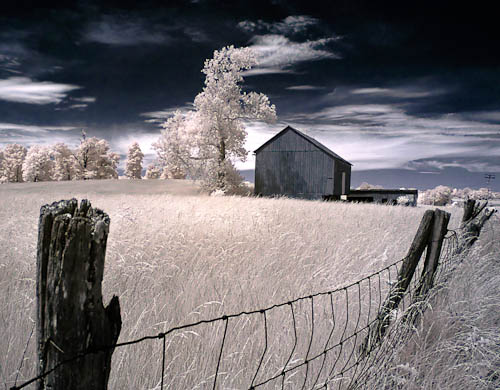
Perhaps my most successful IR image was the “Barn and Tree”, captured just a little way from the location of the hayfield. In fact, you can see the barn in the distance on the left hand side of the hayfield shot. The image shows the most obvious characteristics of IR images, green foliage is rendered white and blue sky is rendered very dark or black.
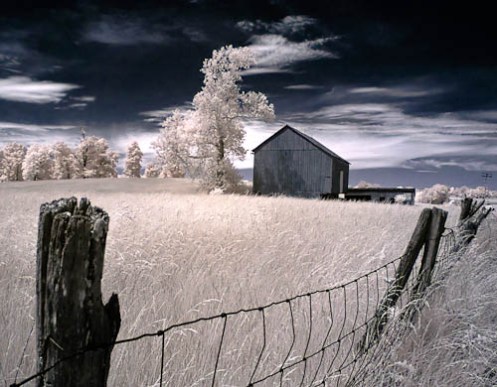
“Barn and Tree in Digital Infrared” (Modified Nikon D100)

Most of the time, IR images are converted to black and white. But in this case, I was fiddling around with the file in Photoshop and stumbled on this color rendition. The colors are just close enough to real to be plausible, but just different enough to add an element of mystery. Sadly the barn is now gone so I’m glad I was able to get a good photo of it while I could.

When I acquired the Nikon D300, I sent the D200 to be modified to give me a higher resolution sensor for IR photography.
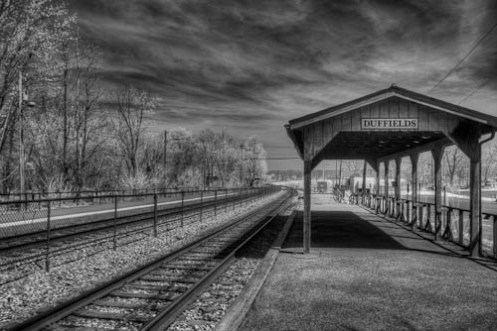
“Duffields Train Station, Jefferson County WV” (Modified Nikon D200)
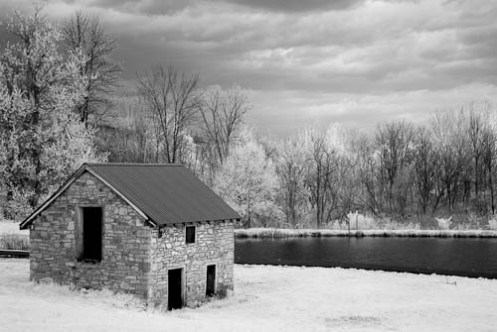
“Spring House, Poorhouse Farm Park, Berkeley County, WV” (Modified Nikon D200)

“Poorhouse Farm Park, Berkeley County, WV” (Modified Nikon D200)

Abandoned Farm

•May 14, 2012 • 1 Comment

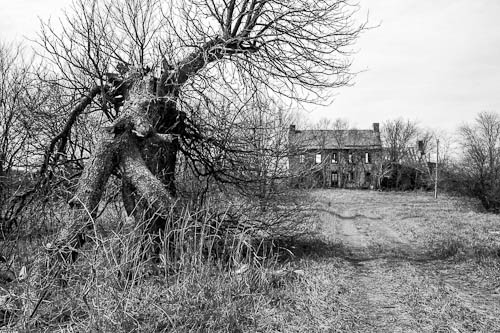
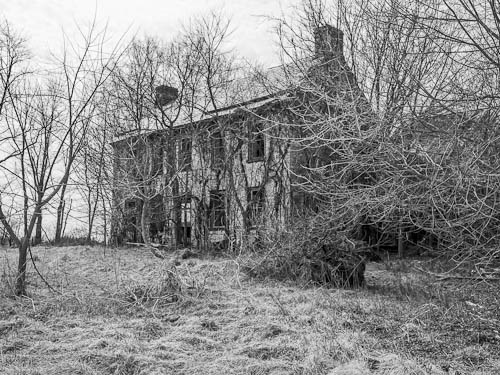
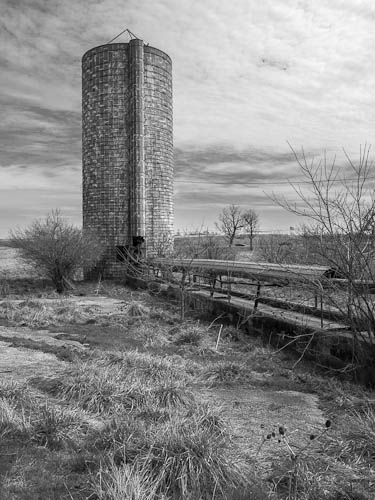
Down Route 11 south of Martinsburg there’s an abandoned farm that I have seen many times. One day I ventured across the field to try to capture this gem from another era before it succumbed to the forces of progress.