Vandalism

•May 12, 2012 • 1 Comment

The other day I was out looking for something to photograph. I drove by the cemetery on South Street in Martinsburg and stopped to see if there was anything. What I found was really sad. One or more really sick people had knocked over a considerable number of the gravestones, creating  a scene of chaos. I am at a complete loss to explain why people would do such a thing.

Thinking Square

•May 9, 2012 • Comments Off on Thinking Square

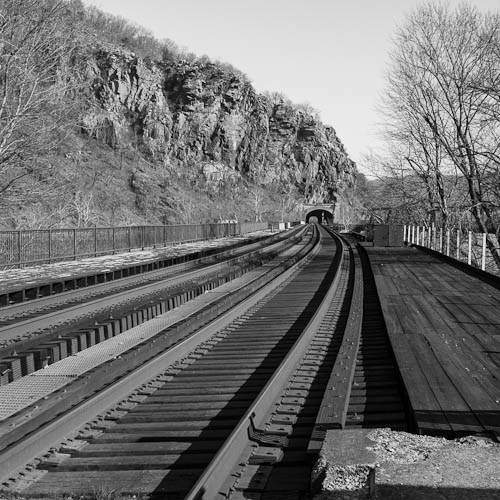
One of the interesting things about the new “mirror less” cameras is that they can be set for different aspect ratios in the camera and the electronic viewfinder. The Panasonic GH2, which I have been using quite a bit over the last year, can produce images in 3:4, 2:3, 16:9, and 1:1. the 1:1 square format was the same as the medium format cameras such as the classic Rolliflex and Hasselblad. I’ve read a couple of articles lately on the Web by photographers who thought that this was a good way to go out with the camera with a “new” perspective.

Of course, it’s easy to crop a square image out of a rectangular image but if you compose the shot in the viewfinder with a square view, you see differently as you compose. Back on one of those ridiculously warm days last March, I visited Harper’s Ferry and shot with the camera set for the square format. The interesting thing was that it felt perfectly natural as I composed the shots in the viewfinder.

Around the Potomac at Shepherdstown

•May 8, 2012 • Comments Off on Around the Potomac at Shepherdstown

(Click on the image to see a larger version.)

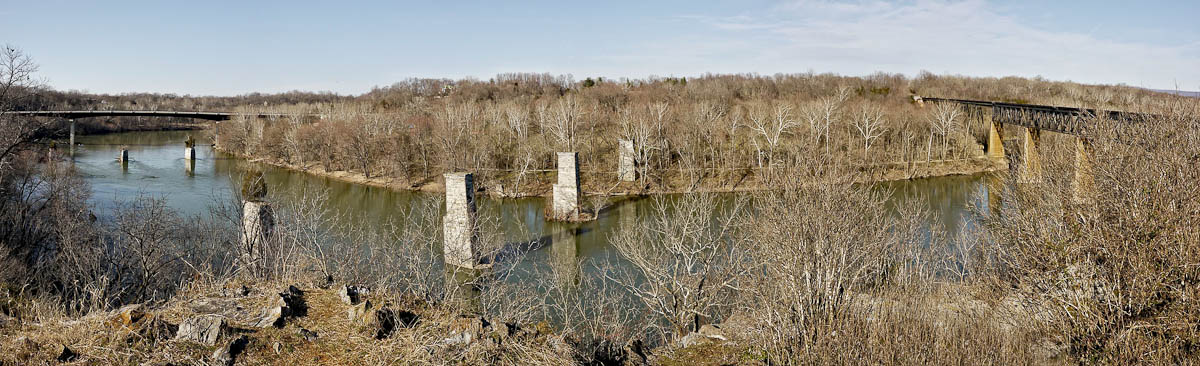
The environment around Shepherdstown offers many opportunities for photographs. The panoramic view from the the James Rumsey Monument Park stretches from the new Rout 340 bridge on the left to the railroad trestle and beyond on the right.

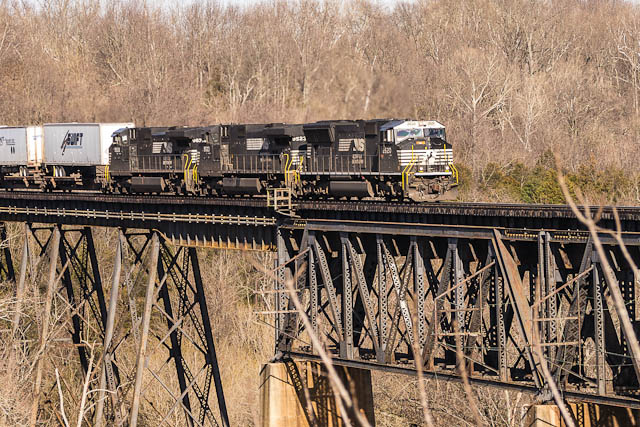
And if you’re lucky, you can catch a freight train crossing the trestle. It seems to me that this is such a narrow and seemingly delicate path for such a heavy load.

From the other side of the river, there are close-up views of the various bridgework ruins.

Checking out my New Toy

•May 4, 2012 • Comments Off on Checking out my New Toy

Olympus Em-5, 14mm f/2.5, 1/5 Sec, f/6.3, ISO 1600

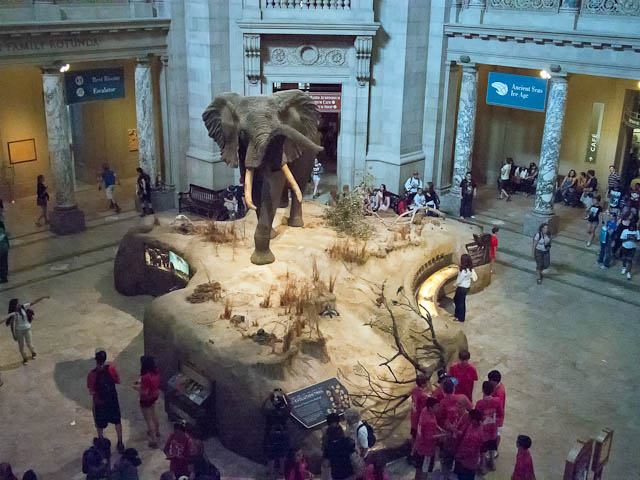
I don’t normally post test shots from a new camera, but I think this one may turn out to be special. It certainly has created a lot of buzz on the Internet and is still very hard to get. I got lucky when I caught it in stock at B&H during a very short window of opportunity last Monday and ordered it. It arrived on Wednesday so Thursday I took off with my friend Cornell Johnson and we headed down to DC (Thanks for driving Cornell!). We finally found a place to park in front of the National Archives and had two hours before they started towing from that spot. So we walked down to the Natural History Museum.

Olympus EM-5, 45mm kf/1.8, 1/250 sec, f/8, ISO 200

The Olympus OM-D EM-5 is the latest in a line of so-called “Micro Four Thirds” cameras. The 16 megapixel sensor is about 25% smaller than the “APS-C” size sensor in my workhorse Nikon D300. But the size and weight differential is extreme. Using three very small prime lenses – one on the camera and one each in my two shirt pockets – I had all the lenses I needed for this outing.

I’ve posted a small gallery of the images here.

I have also been shooting with a Panasonic GH2, also a Micro Four Thirds camera.

Why am I considering these cameras? I suppose that if image quality was the only concern I would be selling off as much stuff as I could and getting ready to buy a Nikon D800

But I am getting to the point where size and weight in a camera kit matters and so I am exploring these small cameras, which are still marvels of new technology. That’s not to say I will not ultimately yield to the temptation to acquire the D800, but in the meantime I am really enjoying working with these small, light cameras and I have been very impressed with the images.

Finally, using a new camera (or anything else for that matter) for the first time will provide many opportunities for mistakes. Yesterday I was fiddling with the settings and accidentally captured a couple of shots at ISO 25,600! Noisy? Definitely, but certainly usable for some things.

Olympus EM-5, 20mm, f/1.7, 1/250 Sec, f/6.3 ISO 25,600

No Photoshop Editing in Lightroom 4

•April 25, 2012 • 1 Comment

A recent article on dpreview.com was about some of the new editing tools in the new Adobe Lightroom. I was aware of these things but haven’t had the time to really try them out.

The updated tools were first released in Lightroom 4 and will be incorporated into Adobe Camera Raw 7 in the new version of Photoshop. The beauty of using these tools is that they allow the adjustment of images “non-destructively”, which means that you can always go back and change it.

A recent presentation at the Jefferson County Photography Club about using tone mapping techniques to create a “pseudo-HDR” effect got me thinking about how far one could go in balancing out the tones in a high contrast situation.

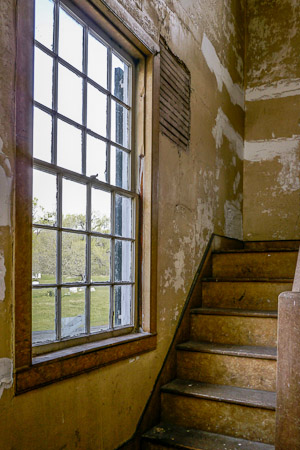
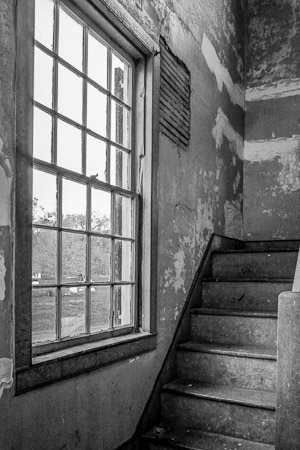
The following shot was very high contrast with a view out a window on a sunny day. Although I had bracketed this shot two stops under and two stops over, I wanted to see if I could get a reasonable tonal balance using only the image that was the default metered exposure. This task was somewhat more complicated because the camera original was a .JPG file as opposed to my usual RAW file. But that’s another story.

The image has some detail at the extremes, but the outside is still overexposed and the interior is under exposed. Using the tools in Lightroom, however, I was able to balance these out nicely.

Having seen the value of the new tone adjustment tools, I decided to take it further so the next step was to straighten out the vertical lines that were a bit skewed due to the camera angle.

Finally, I converted the image to black and white, which is optional in this case but Lightroom has a good tool for this purpose.

Although I don’t think I would ever eliminate Photoshop from my workflow, I think I will be using Lightroom more and more for what I will call “pre-processing”.

For the record, the shot was captured with a Panasonic GH2 Micro 4/3 camera with a 14mm f/2.5 prime lens (28mm equivalent in 35mm).

Cacoctin Creek Aqueduct

•January 31, 2012 • Comments Off on Cacoctin Creek Aqueduct

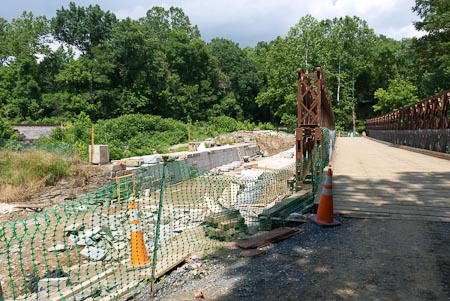
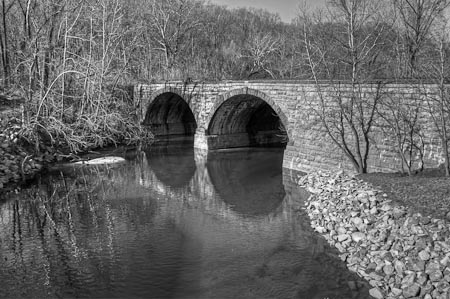
Today brought a respite from winter – sunny and temperatures in the 60’s so I had to get out to find something to photograph. Last June I visited the Cacoctin Creek Aqueduct on the C&O Canal roughly half way between Brunswick and Point of Rocks, MD. When I got there I found the aqueduct in the middle of a major restoration project.

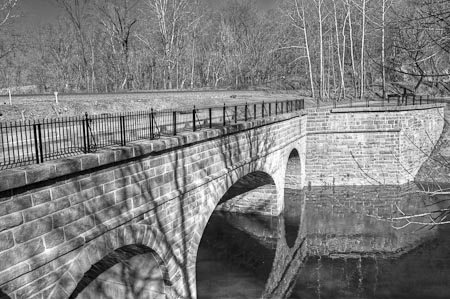
This aqueduct had fully collapsed in 1973 and a wooden footbridge was built so you could continue your walk or bike ride along the canal towpath. So today I thought I would go back and see how the project was going and found it finished! They have done a great job rebuilding the aqueduct. Here are some shots from my visit today.

At this point on the canal the railroad tracks run very close to the path of the canal. When the canal needed a structure to cross the creek, so did the railroad. Just upstream on Cacoctin Creek is the bridge (viaduct?) that carries the CSX main line.

This line is very active. During the approximately hour and a half I was on the canal at least five freight trains passed by. I was only in position to catch one one of them as I passed Lock 29 and the lockhouse. The canal was only commercially viable for a short time and shut down altogether in 1924 because of competition from the railroad. The image says it all.

Two Museum Shows

•January 4, 2012 • Comments Off on Two Museum Shows

Taube Museum, Minot, North Dakota

Now thorugh February 24 eight of my images from the “Forgotten Places: North Dakota” series will on display as part of a group photography exhibit at the Taube Museum of Art in Minot, North Dakota. The exhibit includes photographs by 10 participants in Tillman Crane’s “Spirit of Structure” workshops in 2010 and 2011 in the Rugby, North Dakota area.

Just in case any of my friends happen to be in North Dakota in January, the reception will be on Thursday, January 12 at the museum in Minot.Let me know if you can make it. Dan Smith, North Dakota Photographer and curator for the exhibit, offered to arrange for a real North Dakota Blizzard if I attended the reception. Unfortunately, I will miss that opportunity!

Cumberland Valley Photographic Salon

The 79th Cumberland Valley Photographic Salon at the Washington County Museum of Fine Art opens January 28 and runs through April 29.

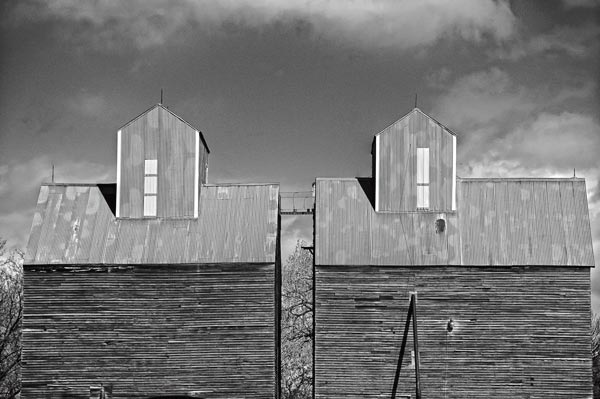
I have not done well in this juried exhibit the last couple of years, but this year I am excited that all four of the prints I submitted were selected by the juror for this year’s exhibit. The images were four out of my “Forgotten Places: North Dakota” series. To have one image selected in this prestigious event would have been fabulous but having all four selected was beyond my wildest dreams!

Grain Elevators, Rolette County

Grain Elevators, Rolette County

The icing on the cake is that my image “Grain Elevators, Rolette County” was awarded the Youngblood Studios Award for this year.

Juror was Bruce Katsiff, photographer and Director of the James A. Michener Art Museum in Doylestown, Pennsylvania.

The reception will be Sunday, February 12 from 2:30-4pm. Please join me to celebrate the continued success of my North Dakota Project.

Moon and Jupiter

•December 10, 2011 • Comments Off on Moon and Jupiter

I haven’t been doing much shooting lately because I have been extremely busy during the holidays with the Berkeley Arts Council Holiday Art and Craft Market. But about a month ago I decided to follow up on my successful moon imaging (see previous post.)

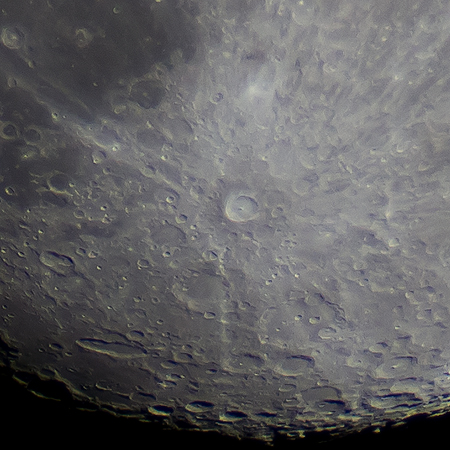
Having just acquired a Panasonic GH2, which is a higher resolution version of the G2 used on the earlier images, I decided to try the new camera. The night was beautifully clear and the moon was high in the sky so I also decided it was time to drag out the “big” telescope – a 120mm Orion refractor with a heavy equatorial mount and a focal length of 1000mm.

The detail I was able to capture was quite amazing once I was able to achieve accurate focus.

Then I turned the ‘scope on Jupiter. Because I haven’t really paid a lot of attention to such things for a while, I did not realize that Jupiter was just past opposition, which is the point of closest approach to us on Earth and therefore looks the largest to us.

I had never viewed Jupiter in a telescope near opposition and I was amazed that I could see several of the cloud bands and I could just make out the “great red spot.” Naturally, with my success photographing the moon, I tried a shot of Jupiter.

This shot is not anywhere near comparable to large telescope images, let alone the deep space probes that have imaged Jupiter and its moons, but I was quite astonished to be able to capture the planet this well with my very modest gear, including being able to just make out the red spot. Also, three out of the four Galilean moons are just visible as tiny points of light.

Having been an “armchair” astronomer most of my life, these image were quite satisfying. I’m now looking forward to more lunar images and waiting for Saturn to come around!

Waxing Moon

•October 5, 2011 • 1 Comment

6 October 2011, 00:44 UTC

Waxing moon photographed with a Panasonic G2 digital camera and a 80mm refracting telescope (400mm). Since the camera is Micro 4/3 the multiplier is X2 so the telescope is equivalent to 800mm on a 35mm camera.

Dunker Church

•October 4, 2011 • Comments Off on Dunker Church

Yesterday was yet another dark, gray day, so I took a ride over to Antietam and photographed the Dunker Church. The small structure has been well restored without losing its 19th century flavor. The cloudy weather outside provided a lovely, soft natural light for the interior.