Workshop UPDATE: FILLED “The Why and How of the Photographic Project”

•February 3, 2013 • Comments Off on Workshop UPDATE: FILLED “The Why and How of the Photographic Project”

The workshop is now filled. If you would like to be notified when the workshop is offered again, please send me an email at sterlingimageswv@gmail.com

I am pleased to be able to offer this new workshop and to share with participants what I have learned in the process of completing two incredibly satisfying projects over the last couple of years.

We, as photographers, are continually looking for inspiration and opportunities to make photographs. Most of us have a collection of images that we feel are our best. Those are the images that end up being submitted to exhibits, displayed on web sites, presented at clubs, and hung on the walls of our homes. At some point you may have reached the point everywhere you look around you and think “been there, done that.”

Rolette County, North DakotaOne definition of art is that it is the process of communicating feeling the artist has about something. With visual arts in general and photography in particular, the process involves showing the “something” in a way that communicates that feeling.

A higher level of communication can be achieved if you can put together a series of images that communicate your feeling about something, so that the viewer can see it from different perspectives, in different light, or at different times.

This workshop is intended to help you through the process of designing, planning, and execution of the project plan, ultimately resulting in the presentation of the project.


Fall Color on Skyline Drive

•October 27, 2012 • Comments Off on Fall Color on Skyline Drive

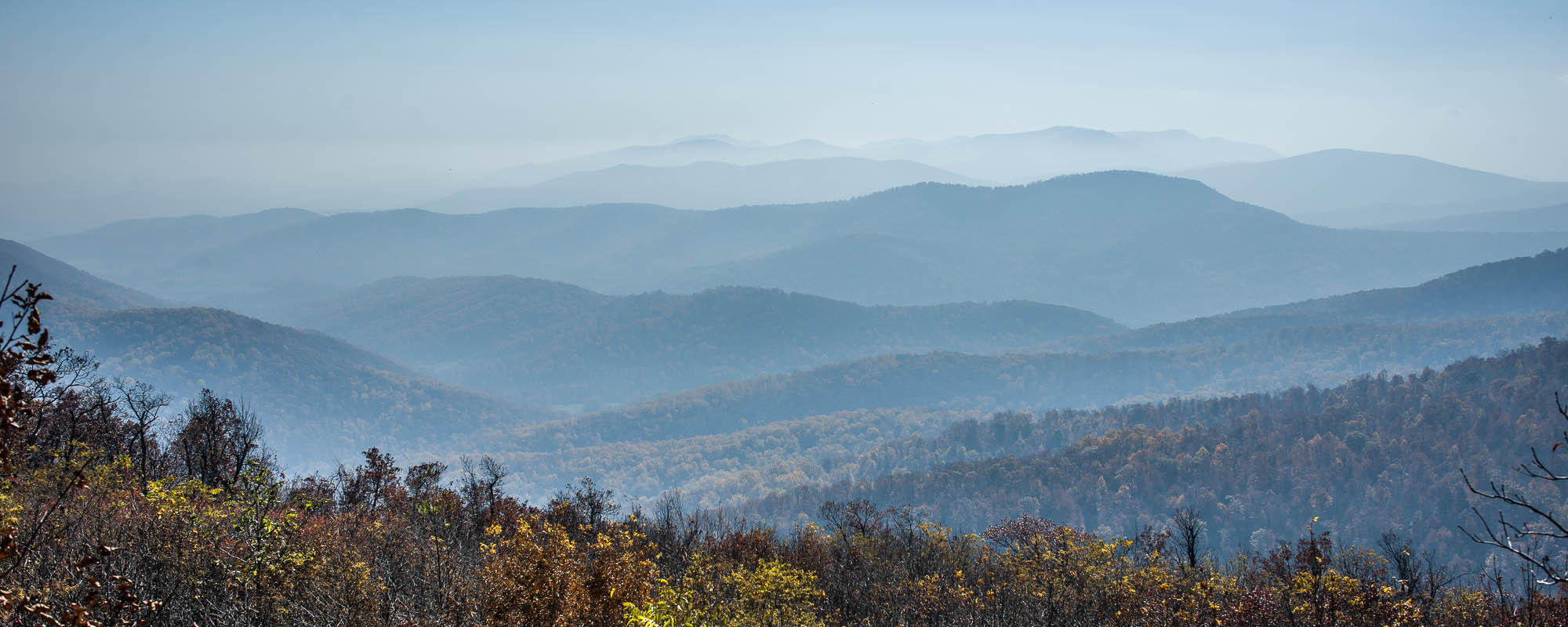
With all of the activity from the “Asylum” project completed, I am looking for other photo opportunities. The other day Malinda and I “played hooky” and took a drive down to Skyline Drive to see the leaves and enjoy a beautiful October day. Starting at the northern entrance in Front Royal, we only drove about 18 miles south on the drive but in that short distance the colors were great in spite of being somewhat beyond the peak.

I was also exercising my new Nikon D600 and I was generally pleased with the way the camera performed. I processed a group of the images and posted them in a new SmugMug gallery.

“Asylum” Book is Done!

•September 28, 2012 • 1 Comment

I am excited that the “Asylum” book is now available in the Washington Street Artists’ Co-op or online. The book presents more than 45 images from the project along with historical notes about the Kirkbride Plan facilities and the Weston hospital in particular.

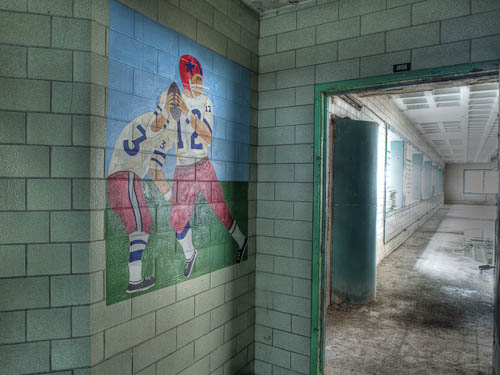
“Asylum” is a photographic exploration of an extraordinary historical site in the heart of rural West Virginia. The Trans-Allegheny Lunatic Asylum (formerly the Weston State Hospital) is the largest cut stone masonry building in the western hemisphere, second in the world only to the Kremlin in Moscow. Closed and abandoned for many years, the building was closed and abandoned. Now privately owned, it is being preserved and partially restored and is open to the public for tours, ghost hunts, and other events.

Click on the thumbnail on the left to see a preview of the book.

The book is available online from Createspace, a division of Amazon, at https://www.createspace.com/3993382.

The “Asylum” exhibit is also on display in the Fire Hall Gallery at the Washington Street Artists’ Co-op and the Charles Town Visitors’ Center, 108 North George Street, Charles Town, WV. I will be in the gallery for a reception and book signing Saturday, October 6 from 6-8pm.

“Asylum” – Other Buildings

•September 19, 2012 • Comments Off on “Asylum” – Other Buildings

My “Asylum” exhibit and book project has concentrated primarily on the main building in the Trans-Allegheny Lunatic Asylum complex. I wanted to explore the the “Kirkbride” building in as much depth as possible, so I did not spend much time on any of the other buildings. Hopefully they will continue to be there and available for future study.

I did visit a couple of them and one of the more significant was what is called the “Forensics Building.” This was a higher security facility for housing mentally ill criminals who were kept there while they were being evaluated, usually on orders from a court, to determine their competence to stand trial.

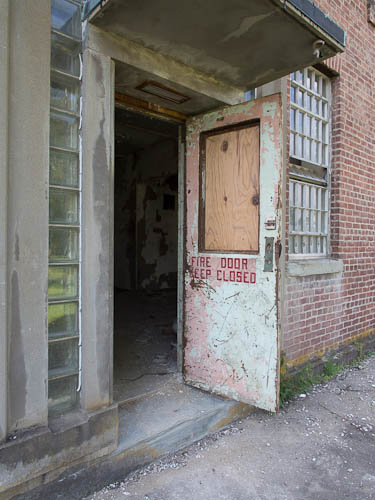
Another building that was open during one of my visits was the “Women’s Auxiliary” building. The people I asked about it were not sure why it was called that. One thought it was because it housed only women. Another said that it was just for the general patient population, possibly during the time when the main building was so overcrowded. It was closed more than 20 years before the main building was closed and is in very rough condition. There has been no attempt at cleanup or restoration.

How Big Is It?

•September 12, 2012 • 1 Comment

The Trans-Allegheny Lunatic Asylum (Formerly Weston State Hospital)

The subject of my upcoming exhibit, The Trans-Allegheny Lunatic Asylum is big. How big is it? The Kirkbride building is said to encompass nine acres of floorspace. It is reputed to be close to a quarter mile long.

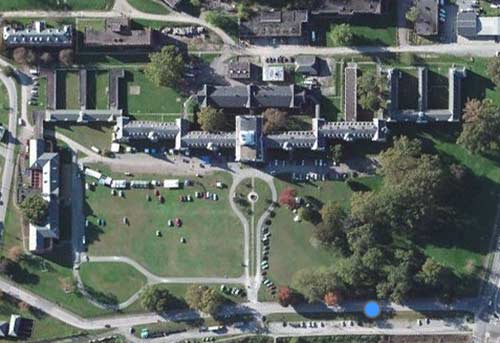
It is virtually impossible to capture the full extent of the Kirkbride building with a single image, except from the air.

Satellite image from Bing Maps. The original southern ring is at the left end.

The satellite image from Bing Maps shows the full extent of the Kirkbride building as well as some of the surrounding structures in the complex. The staggered pavilions forming the shallow V are clearly seen, starting with the original southern wing that was first opened to patients in 1864.

“Asylum” Exhibit Historical Context, Part 2

•September 11, 2012 • Comments Off on “Asylum” Exhibit Historical Context, Part 2

This is a continuation of the historical information about the subject of my upcoming exhibit.
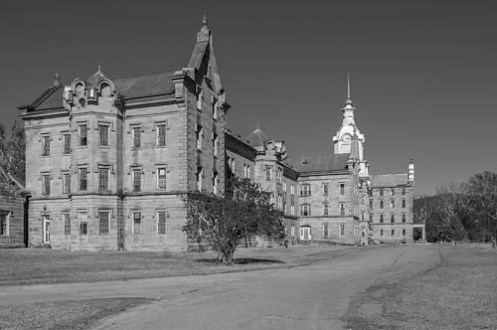
The Trans-Allegheny Lunatic Asylum (Formerly Weston State Hospital)

The Trans-Allegheny Lunatic Asylum

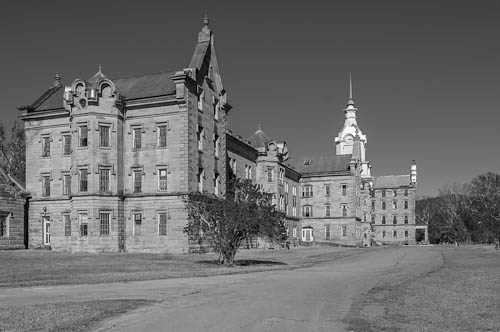
The Trans-Allegheny Lunatic Asylum, later known as the Weston State Hospital for the Insane, is the largest hand-cut stone masonry building in the Western Hemisphere, second in the world only to the Kremlin in Moscow. It was designated a National Historic Landmark in 1990 and is one of the best examples of the Kirkbride Plan that is still intact.

The Virginia General Assembly authorized the asylum in the early 1850s after consultation with Thomas Kirkbride. At the time, Kirkbride was the Superintendent of the Pennsylvania Hospital for the Insane. The asylum was designed in the Gothic Revival and Tudor Revival styles by architect Richard Snowden Andrews, who had designed the Maryland Governor’s residence in Annapolis and the southern wing of the U.S. Treasury Building in Washington, DC.

Construction began in Weston, Virginia in 1858, primarily by prison laborers. Later, skilled stonemasons were brought in from Germany and Ireland. Construction was interrupted by the outbreak of the Civil War. When the war started, the southern wing was completed and the central structure partially complete.

On the morning of June 30, 1861 elements of the Seventh Ohio Infantry under the command of Colonel Erastus Tyler, having marched all night from Clarksburg, entered the town and rounded up those suspected of having Confederate sympathies. Tyler’s mission was to seize some $30,000 in gold (well over half a million dollars today) that had been deposited by the Virginia State government to pay those working on the new asylum, before it could be returned to Richmond and used to support war effort. The banker, Robert McLandish, relinquished the gold after offering token objections. The gold was taken to Wheeling, which eventually became the first capitol of the new state of West Virginia.

The partially built asylum became Camp Tyler and was used throughout the war as a Union base, although the camp changed hands several times during the conflict.
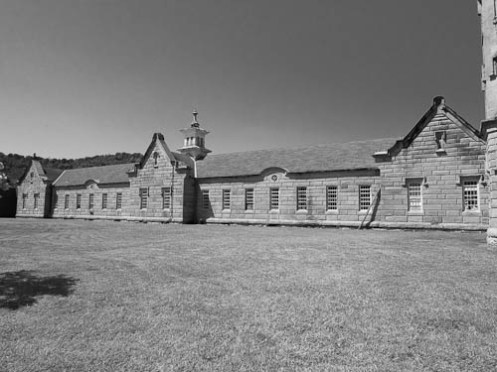
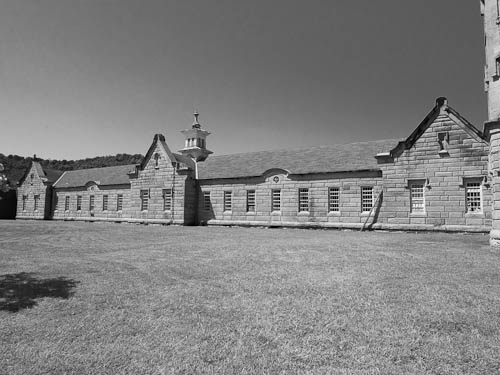
The original southern wing of the asylum as it is today.

Funding was restored for construction of the asylum, which was renamed the Weston State Hospital for the Insane in 1862 by the Reorganized Government of Virginia, which eventually became the new state of West Virginia. The first patients were admitted to the southern wing in 1864 while construction continued until 1881.

The hospital complex was designed to be self-sufficient, with a farm, dairy, water supply and even a cemetery located on the grounds.

This hospital was consistent with other Kirkbride facilities being originally designed to provide “refuge” for 250 patients. But the population of this hospital, as with the others, could not be controlled to that extent. According to wikipedia.org, the patient population grew to 717 by 1880 to its peak at about 2,600 in the 1950s in serious overcrowded conditions.

Eventually, due to changes to the treatment of mental illness and other reforms, the population of the hospital declined.  The construction of the William R. Sharpe Jr. Hospital began in 1986 and the old Weston State Hospital was closed in 1994.

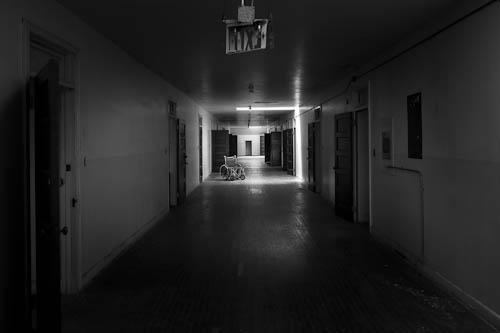
The emptiness of the asylum today gives no hint of what it would have been like with up to 2,600 patients within its walls.

The Kirkbride building and complex including a medical hospital, and other buildings were closed and vacant until 2007 when it was purchased by Morgantown contractor Joe Jordan. With some government funding and private donations, Jordan has begun maintenance and restoration projects in and around the main building. As of this writing (September, 2012) Joe Jordan’s organization has restored parts of the main building and offers regular guided historical tours, nighttime ghost hunts and tours, photo tours and other special events to raise money.

More information is on the web at trans-alleghenylunaticasylum.com.

“Asylum” Exhibit Historical Context

•September 9, 2012 • Comments Off on “Asylum” Exhibit Historical Context

My upcoming exhibit is a photographic exploration of an extraordinary architectural and historical artifact. My upcoming book, also titled “Asyum” will present an expanded selection of images. In viewing the images in the gallery or in the book, I felt some historical context would be useful. The following is from the book’s introduction.

A Bit of History

Up to the early part of the nineteenth century, little was known about mental illness and as a result, the treatment of mentally ill people was generally barbaric. Different types of mental illness were generally lumped together as being “insane.” Insanity was often attributed to some moral failing or even the work of the devil. Because insane people were often disruptive, threatening, or at the very least exhibited behavior that was strange, they were isolated as much as possible from the community at large. Many “lunatics” were placed in jails or almshouses and kept in horrific conditions. Often they were chained to the wall in cold, damp basements. If they were fortunate to have some family to look after them, they were still often hidden away in attics or cellars so as not to be an embarrassment to the family.

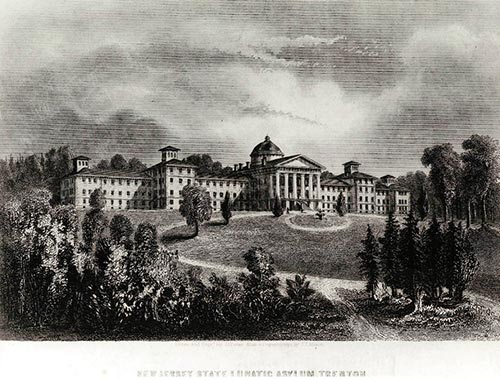
Things began to change in the 1840s, partially as a result of the efforts of Dorothea Dix, a New England schoolteacher. Dix travelled widely to expose the plight of the insane and convince state governments to fund asylums for the mentally ill. Her first success was the establishment of the New Jersey State Lunatic Asylum in 1848.

New Jersey State Lunatic Asylum, Trenton
Drawn and engraved by J.J. Pease from a daguerreotype by J.X. Mason.

The Kirkbride Plan

In the mid-nineteenth century, the dominant school of thought was that the insane could be cured by being treated in specially designed buildings. It was believed that the architecture of the building itself would have a curative effect.

It was also thought that insanity could be caused by the stresses of modern life so locating these asylums in beautiful rural environments and away from the cities and commercial/industrial centers added to the overall curative benefit.

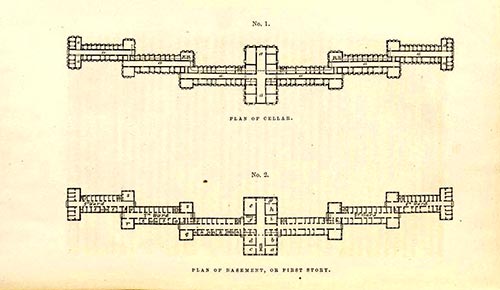
The New Jersey asylum followed a plan developed by psychiatrist Thomas Storey Kirkbride. In the United States in the mid-nineteenth century, the Kirkbride plan was considered the most advanced approach to medical architecture in general and the treatment of the mentally ill in particular.  The basic design featured pavilions that were connected and arranged in a shallow V in order to maximize the sunlight and fresh air for the patients.

Plate No. 1 and No. 2 from Thomas Story Kirkbride’s “On the Construction, Organization, and
General Arrangements of Hospitals for the Insane,” Philadelphia, 1854. p. 40.
(Wikipedia Commons)

Integrated into the Kirkbride Plan was the concept of “moral treatment,” which encouraged a generally healthy lifestyle, healthy eating, exercise, and other positive activities within the context of a highly controlled environment. Patients who behaved well were allowed outside to walk around the grounds and were allowed other privileges. Patients who behaved badly were often punished by being denied privileges or isolated from the other patients. Violent patients were often locked in “seclusion rooms.”

Ultimately the Kirkbride plan was used in the design of dozens of asylums in the United States.

The overall treatment of the patients was greatly improved over early nineteenth century standards, but some of the treatments today would still be considered barbaric. The “ice-pick lobotomy” stands out as being particularly horrific.

Still, the development of these asylums at least represents an acknowledgement that mentally ill people deserved some effort by a trained medical community to understand and treat mental illness.

A fascinating and detailed historical discussion of the history of architecture in the treatment of the mentally ill is The Architecture of Madness: Insane Asylums in the United States by historian Carla Yanni. Paper bound hard copy and Kindle versions are available from Amazon.com.

(Updated) Asylum Exhibit to Open October 6

•August 23, 2012 • 1 Comment

Update:

The exhibit will be on display starting Wednesday, September 26 in the Firehouse Gallery. The reception is still scheduled for October 6.

I’m pleased to announce that I will be showing a selection of images from my new project “Asylum” at the Old Firehouse Gallery in the Washington Street Artists’ Co-op in Charles Town, West Virginia. The co-op and gallery are located in the Charles Town Visitors’ Center at 108 North George Street in Charles Town. The exhibit will open October 6 with a reception from 6-8pm and run through the end of October.

I first learned about the Trans-Allegheny Lunatic Asylum a couple of years ago when I was browsing the web. At the time I had completed my second trip to North Dakota to photograph abandoned farms and other abandoned places. I was looking for photography projects a little closer to home. In August of 2011, I was driving home from a short trip to southern West Virginia and decided to stop in Weston to see what was there. Although I had seen some photographs on the Web, none of them even came close to doing the place justice.

Following the signs from Interstate 79 that pointed to “Historic Asylum Tours”, I turned a corner in the middle of the town of Weston and before me was an amazing building to be located in the middle of a small town in rural West Virginia.

The former Weston State Hospital, recently renamed to its original name of Trans-Allegheny Lunatic Asylum, is the largest cut-stone masonry building in North America, second in the world only to the Kremlin in Moscow.

At that point I was hooked.

I noticed that the driveway was open and there were cars parked in front of the building so I drove in, parked, and found the front entrance open. They were getting ready to start a tour of the facility so I signed up for it and followed along. I brought my camera and took some hand-held shots along the way, mostly just to record what was there.

Once I got home and looked through the casual images I decided I wanted to make an effort to do some more serious photography in the building, and to try to capture the feel of the place.

Subsequently, I made three trips to Weston to photograph the building and surroundings. The images in the exhibit are the result of that effort.

Music Everywhere

•August 23, 2012 • Comments Off on Music Everywhere

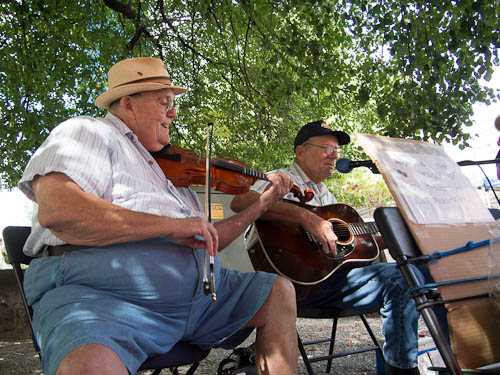
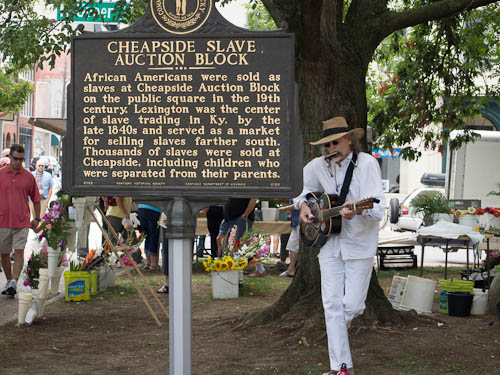
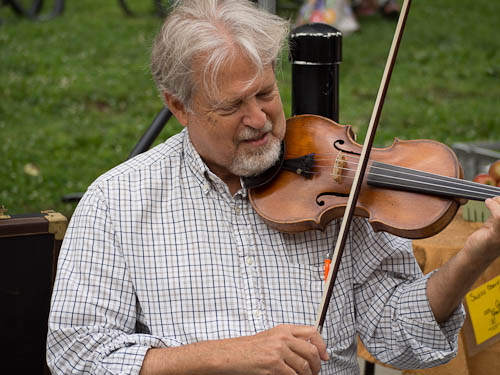
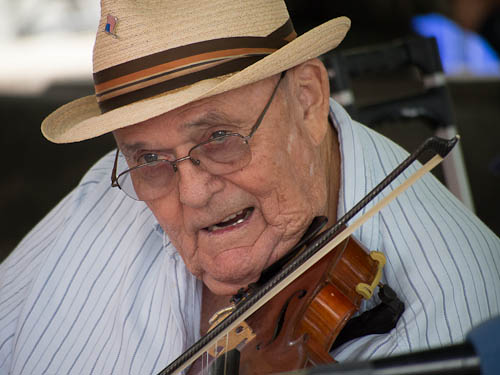
The street musicians were out in force at the Lexington, Kentucky Farmers Market. No matter where I walked, I could hear music from old time bluegrass to classical cello, to blues, and more.

Kentucky Horse Country

•August 17, 2012 • 2 Comments

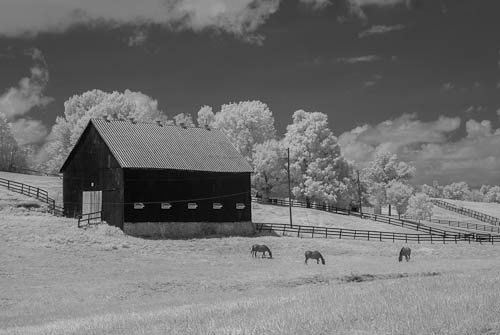
While in Kentucky, I couldn’t fail to take a drive in the country to see the horse farms in the “capitol” of thoroughbred horse country. I took along my Nikon D200IR and captured a few infrared images.